The Supreme Court has ruled that a Governor cannot send bills to the President for consideration if the state assembly has already cleared them for a second time. The court was questioning the Centre over the powers of the Governor when it comes to granting assent to bills.
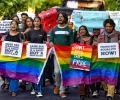
A five-judge bench of the Supreme Court will consider review pleas challenging the October 2023 verdict that declined legal sanction to same-sex marriage. The review pleas will be heard in chambers on January 9, with Justice P S Narasimha being the only member of the original bench that delivered the verdict.
It will be court's opinion versus the legislative power to enact law, the Supreme Court on Wednesday said as it posted the pleas challenging the appointment of the chief election commissioner and election commissioners under the 2023 law on February 4.

Aligarh Muslim University is not a minority educational institution, Supreme Court's Justice Dipankar Datta said on Friday and noted had it not been a "race against time" he would have articulated better in his dissenting opinion. The judge also flagged a non-exchange of ideas and opinions in a "true democratic spirit" to build a consensus.
The Supreme Court on Thursday dismissed a batch of pleas seeking to review its October 2023 verdict declining legal sanction to same-sex marriage.
A Constitution bench comprising Chief Justice B R Gavai and Justices Surya Kant, Vikram Nath, P S Narasimha and A S Chandurkar, would fix the timelines on July 29 and commence hearing on the presidential reference in mid-August.
The Centre has told the Supreme Court that imposing fixed timelines on governors and the president to act on bills passed by a state Assembly would amount to one organ of the government assuming powers not vested in it by the Constitution and lead to a "constitutional disorder".
The Supreme Court of India has repeatedly criticized the Enforcement Directorate (ED) for exceeding its authority and misusing its powers. The latest rebuke came on Thursday, when the court accused the agency of 'crossing all limits' in a money laundering probe against a Tamil Nadu state-run liquor retailer. This follows a string of similar observations by the Supreme Court and high courts across India, raising concerns about the ED's investigative practices and the potential for misuse of its powers.

The CJI, who hails from Andhra Pradesh, had said in the last hearing that he belonged to both the states and suggested 'mediation' to Andhra Pradesh and Telangana for settling their dispute, saying it did not want to interfere 'unnecessarily'.

The Supreme Court on Thursday upheld the constitutional validity of Section 6A of the Citizenship Act related to the grant of Indian citizenship to illegal immigrants in Assam by a majority verdict of 4:1.

The Supreme Court on Friday deferred the question of Aligarh Muslim University's minority status to a fresh bench and overruled the 1967 judgment that said the university cannot be considered a minority institution since it was created by a central law.
The Supreme Court of India has stayed a Lokpal order that allowed complaints to be filed against a sitting high court judge. The court termed the order "something very, very disturbing" and a concern for the independence of the judiciary. The bench issued notices to the Centre, the Lokpal registrar, and the complainant, directing them to keep the identity of the judge confidential. The court will hear the matter again on March 18.

The Supreme Court has taken cognisance of the Lakhimpur Kheri incident in which eight people were killed in violence during a farmers' protest, with a bench headed by Chief Justice of India N V Ramana scheduled to hear the matter on Thursday.

Congress leader Rahul Gandhi has criticized the government's decision to appoint Gyanesh Kumar as the new Chief Election Commissioner (CEC) in the middle of the night, arguing that it is "disrespectful" and "discourteous" given the ongoing Supreme Court challenge to the selection process. Gandhi presented a dissent note to the selection committee, stating that the process violates the Supreme Court order and undermines the integrity of the electoral process.

The Supreme Court of India will examine the jurisdiction of the Lokpal, India's anti-corruption ombudsman, in entertaining complaints against sitting high court judges. The court is considering a suo motu proceeding initiated over the Lokpal's January 27 order on the issue. The case involves two complaints filed against a sitting additional judge of a high court, alleging that he influenced a judge of the subordinate judiciary and a judge of the same high court set to deal with a suit filed against the complainant by a private company.

Kejriwal, who was arrested on March 21 by the Enforcement Directorate (ED) in the same case and later by the CBI which was probing corruption charges, stepped out after spending 155 days in Tihar jail. The AAP supremo, who was earlier granted three-week interim bail in the ED case, was given a resounding welcome by his party leaders and supporters who were drenched in heavy rain. Addressing party workers from the top of an SUV, Kejriwal, sporting a half-sleeve blue shirt, raised 'Inquilab Zindabad' and 'Vande Mataram' slogans.
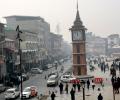
Highlights of the judgment pronounced by a five-judge Constitution bench of the Supreme Court that on Monday unanimously upheld the Centre's decision to abrogate provisions of Article 370 of the Constitution bestowing special status on the erstwhile state of Jammu and Kashmir.
In a viral video of the court proceedings, the judge was seen reprimanding a woman lawyer on Thursday and reportedly made some objectionable comments.

Section 6A, which was incorporated in the Citizenship Act 1955 following the signing of the 1985 Assam Accord, was upheld by the Supreme Court.
Four special benches will start functioning in the Supreme Court from next week to hear criminal appeals, direct and indirect tax and land acquisition matters and motor accident claim cases, Chief Justice of India Justice D Y Chandrachud said on Wednesday.
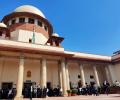
A five-judge bench headed by Chief Justice DY Chandrachud considered the pleas in chambers and dismissed applications for listing of the review petition in open Court.

Hailing the Supreme Court's verdict upholding the government's decision to abrogate Article 370 of the Constitution as "historic", Prime Minister Narendra Modi asserted on Monday that it is not just a legal judgment, but a "beacon of hope" and a testament to the collective resolve to build a stronger and more united India.

On February 1, grappling with the intractable issue of the AMU's minority status, the top court said the 1981 amendment to the AMU Act, which effectively accorded it a minority status, only did a "half-hearted job" and did not restore the institution the position it had prior to 1951.

The Supreme Court on Wednesday expunged the observations made by a single judge bench of the Punjab and Haryana high court against the apex court in a contempt case, saying they were "scandalous" and "unwarranted".

The bench posed questions to senior advocate Gopal Sankaranarayanan, appearing for one of the petitioners Soayib Qureshi, who has challenged the Centre's August 5, 2019 decision to abrogate the provision.

The Supreme Court on Friday said it will take a decision on the early listing of petitions challenging the Centre's decision to abrogate provisions of Article 370 which had given a special status to Jammu and Kashmir.

In an emphatic victory for the Modi government, the Supreme Court on Monday unanimously upheld its decision to abrogate Article 370 of the Constitution that bestowed special status upon the erstwhile state of Jammu and Kashmir, ordered restoration of statehood "at the earliest" and set a September 30, 2024, deadline for holding the assembly elections.

A five-judge bench headed by Chief Justice D Y Chandrachud noted that Karnataka high court judge Justice Vedavyasachar Srishananda, who had made those observations, had on September 21 tendered an apology for his comments in the open court there.

Article 370 of the Constitution, which bestowed special status on the erstwhile state of Jammu and Kashmir, was a 'temporary provision' and any interpretation of the provision cannot postulate that integration of J-K with India was temporary, the Supreme Court ruled on Monday.

The letter petition said that it be treated as a PIL and the adverse remarks made during the hearing be declared as "uncalled for."

The Supreme Court of India on Wednesday said it would consider a plea for early listing of petitions challenging the Centre's decision to abrogate provisions of Article 370 which had given special status to Jammu and Kashmir.
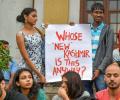
The apex court will have to re-constitute a five-judge bench to hear the pleas after Dussehra vacation as the ex-CJI Ramana and Justice R Subhash Reddy, who were part of the five-judge bench which had heard the pleas, have retired.
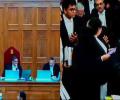
Who can recommend the revocation of Article 370 in Jammu and Kashmir when no constituent assembly exists there? The Supreme Court on Wednesday put this question to the petitioners who have challenged the abrogation of the constitutional provision that bestowed special status on the erstwhile state.

Merely because an educational institution is regulated by a statute does not take away from it the character of a minority institution, the Supreme Court observed on Tuesday as it commenced hearing the vexed question of minority status of Aligarh Muslim University (AMU).

The five-judge constitution bench headed by Chief Justice DY Chandrachud, which heard their contentions at length, told them they will have to justify the procedure adopted for abrogation as the court cannot postulate a situation "where the ends justify the means".
Tewari, a Congress leader and Lok Sabha MP, was appearing for former Arunachal Pradesh MLA Padi Richo, who has filed an intervention application in a batch of petitions challenging abrogation of Article 370.
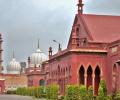
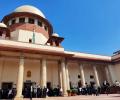
There is nothing "fundamentally inconsistent" with a minority institution being an institution of national importance (INI), the Supreme Court said on Wednesday while hearing arguments on the vexed issue of minority status to Aligarh Muslim University (AMU).

How does it matter for people whether the Aligarh Muslim University is a minority institution or not when it has continued to be an institute of national importance without the minority tag, the Supreme Court said on Thursday as it underlined that the intent of Article 30 of the Constitution is not to "ghettoise the minority".

Expressing displeasure over a tweet posted by a media organisation which falsely claimed that Chief Justice of India N V Ramana had met the kin of victims of Lakhmipur Kheri violence, the Supreme Court on Friday said it respects the media and their independence but this is 'not at all fair.'
The Supreme Court on Monday ruled the former state of Jammu and Kashmir did not have any 'internal sovereignty' that was distinguishable from the powers and privileges enjoyed by other states in the country.
